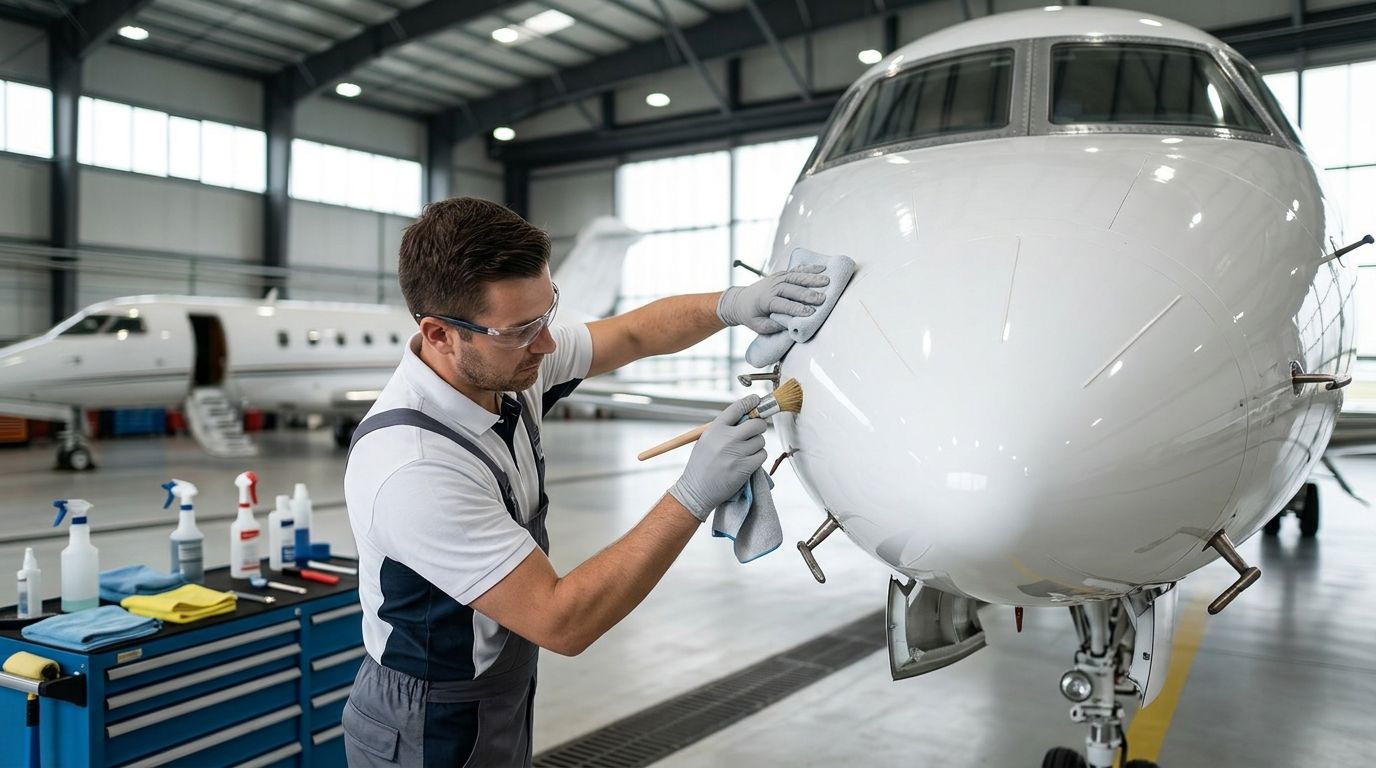
Aircraft detailing is safe for avionics and exterior sensors when the technician masks pitot tubes, static ports, and antennas before any water or chemical touches the airframe. The risk isn't the wash itself — it's a rushed job that treats an airplane like an oversized car.
- Aircraft detailing is safe for avionics and sensors when pitot tubes, static ports, and antennas get covered before washing.
- The real danger is pressure washers, harsh solvents, and skipped masking steps, not the cleaning process itself.
- Ceramic coating and paint correction methods that work on cars apply to aircraft paint, but the technique changes near sensors.
- Glass cockpit displays and interior electronics need anti-static, ammonia-free cleaners to avoid streaking or static buildup.
Why this matters
A private aircraft, flight school trainer, or charter plane can't afford a fouled pitot tube or a scratched static port. Those components feed the airspeed indicator and altimeter directly — get one wrong and the aircraft doesn't fly until it's inspected and corrected. That's a bigger deal than a swirl mark on a car hood.
Royal Touch Mobile Detailing treats aviation exteriors as a separate category from auto and RV work for exactly this reason. Owners of private aircraft, luxury and performance vehicles, flight schools, and charter operators across North Carolina and parts of Virginia and South Carolina need detailing that protects appearance without touching anything that keeps the aircraft flying safely in 2026.
Is aircraft detailing safe for avionics and exterior sensors?
Yes, as long as the sensitive components get identified and covered before any wash step starts. The table below shows where the actual risk sits and what a careful detailer does differently.
| Component | Risk if handled wrong | Safe detailing practice |
|---|---|---|
| Pitot tubes | Water intrusion skews airspeed readings | Cover with a pitot cover before washing |
| Static ports | Trapped moisture or debris throws off altimeter readings | Mask the port; never spray directly into it |
| Antennas & GPS domes | Harsh solvents can degrade the radome coating | Use pH-neutral cleaners, avoid high-pressure spray |
| Sensor housings (AOA, TAT probes) | Contact can bend or misalign the probe | Hand-wipe around the housing, never over it |
| Glass cockpit displays | Streaking or static buildup from the wrong cleaner | Use anti-static, ammonia-free glass cleaner inside the cabin |
The verdict: aircraft detailing is safe for avionics when the process is built around masking, not around speed. A tech who covers the pitot-static system before the first rinse is doing the job right the first time.
Static ports and pitot tubes: the most sensitive spots on the airframe
The pitot-static system is the part of the aircraft most owners worry about, and for good reason. Water sitting in a static port or pitot tube doesn't dry out on its own the way it would on a car's door handle — it can sit there and throw off pressure readings until a mechanic clears it.
A detailer working an aircraft exterior covers these ports before any rinse, foam, or wipe-down begins. That's a five-minute step that prevents a much longer conversation with a mechanic.
Antennas, GPS domes, and sensor housings need a different touch
External antennas and GPS domes are coated to manage signal transmission, and that coating doesn't hold up to the same degreasers or high-pressure spray that strip bug residue off a car's grille. A detailer familiar with aviation work switches to pH-neutral products and hand application around these zones instead of blasting them the way a bumper gets treated.
Angle-of-attack sensors and temperature probes carry a different risk: physical contact. These housings are thin and precisely aligned, so a rag dragged across one instead of around it can bend it out of calibration. The fix isn't a special product — it's slowing down and wiping around the housing, not over it.
Interior avionics and glass cockpit displays
Inside the cabin, glass cockpit displays and touchscreens react badly to ammonia-based glass cleaners — the same ones that work fine on a car windshield can haze or streak an avionics screen over time. Anti-static, ammonia-free cleaners applied to a cloth (never sprayed directly on the screen) keep displays clear without static buildup that attracts dust right back.
Interior electronics near the panel also need dry treatment only. No soaking, no aerosol sprays near vents or switch housings — a slightly damp microfiber cloth does the job without introducing moisture where it doesn't belong.
Why the risk varies from one aircraft to the next
- Age of the airframe — older wiring runs and analog gauges tend to be more exposed than sealed modern avionics bays.
- Flush-mount vs. external antennas — external antennas take more direct exposure during a wash than flush-mounted units.
- Glass cockpit vs. analog panel — touchscreen displays are more sensitive to cleaner chemistry than analog gauge faces.
- Storage conditions — hangar-kept aircraft accumulate less grime buildup than tie-down aircraft exposed to weather.
- Technician background — a detailer who only works on cars may not know which components need masking on an airframe.
- How recently the aircraft flew — fresh oil streaks or exhaust soot near the tail need different handling than a routine surface wash.
Book aviation detailing done right
Mobile detailing for private aircraft across NC and parts of VA and SC.
Can you wash an airplane exterior the same way you wash a car?
No, and this is the biggest mistake first-time detailers make. Car washing assumes every surface can take direct spray and pressure; aircraft washing requires masking the pitot-static system and antennas first, then working the rest of the airframe by hand or low-pressure rinse.
Does ceramic coating work on aircraft paint the same way it does on cars?
Generally yes — a ceramic coating protects aircraft paint from UV fade and contaminant etching the same way it protects a car's clear coat, though application near sensors and rivet lines needs a lighter, more deliberate hand. Owners comparing coating options for a car first can review the ceramic coating cost breakdown to understand the general process before asking about aircraft-specific application.
How often should a private aircraft or charter plane be detailed?
There's no fixed schedule that fits every aircraft — flight hours, hangar versus tie-down storage, and regional exposure to salt air or road-adjacent grime all change how fast an exterior needs attention. Owners flying more frequently or storing outdoors typically need more frequent exterior care than a hangar-kept aircraft flown occasionally.
FAQ
Is aircraft detailing safe for avionics?
Yes, aircraft detailing is safe for avionics when pitot tubes, static ports, and antennas are masked before washing. The risk comes from skipping that step, not from cleaning the aircraft.
Can detailing damage a pitot tube?
Detailing can damage a pitot tube if water is sprayed directly into it without a protective cover. Covering the tube before any rinse step prevents this entirely.
What cleaners are safe near aircraft antennas?
pH-neutral cleaners applied by hand are safe near aircraft antennas and GPS domes. High-pressure spray and harsh solvents can degrade the radome coating over time.
Is ceramic coating safe on aircraft paint?
Ceramic coating is generally safe on aircraft paint and protects it from UV fade the same way it protects a car's clear coat, though application near sensors requires a more careful hand.
Can I use a car cleaner on an aircraft glass cockpit display?
No, ammonia-based glass cleaners made for car windshields can haze avionics touchscreens over time. Anti-static, ammonia-free cleaners applied to a cloth are the safer choice.
Does washing an aircraft require special training?
Washing an aircraft doesn't require a certification, but it does require knowing where the sensitive components are. A detailer used to only working on cars may not know which parts need masking.
What happens if water gets into a static port?
Water trapped in a static port can throw off altimeter readings until a mechanic clears the line. Masking the port before any wash step prevents this.
Is paint correction safe to use on an aircraft?
Paint correction is safe on an aircraft when the technique matches the paint condition, similar to how correction is staged on cars. Areas near rivet lines and sensors need a lighter pass than open fuselage panels.
One last thing
The most common cause of avionics trouble during detailing isn't water at all — it's compressed air blown into a static port to "dry it out" faster, which can push debris deeper into the line instead of clearing it. The safest move is always the slower one: mask it, wipe around it, and leave the pitot-static system alone until the exterior wash is done.