Choosing between window tint brands matters more in North Carolina than most places, because state law caps how dark you can go and the summer sun tests every film's heat rejection claims for real. This guide ranks the window tint brands worth considering for daily drivers, luxury and performance vehicles, RVs, and private aircraft heading into 2026, and tells you which one fits your situation.
- 3M Color Stable wins as the best window tint brand overall for daily drivers who want a film that won't fade or bubble.
- XPEL Prime XR Plus is the pick for luxury and performance vehicles that need top-tier clarity and heat rejection.
- SunTek CXP is the best budget window tint option for drivers who still want a no-fade carbon film.
- LLumar CTX suits RV and aircraft glass where large, flat panels need consistent coverage.
- North Carolina limits front and back side window tint to 35% VLT, so brand choice matters less than legal compliance.
Why this matters
A window tint brand isn't just a look. It's UV protection for your skin and your dashboard, heat rejection that keeps your cabin livable in a July parking lot, and in North Carolina, a legal line you can't cross without risking a citation. Front and back side windows must let in at least 35% of visible light under state law, and only the top 5 inches of the windshield can carry a nonreflective strip.
That's the frame every brand on this list gets measured against. Royal Touch Mobile Detailing installs window tint across North Carolina and into parts of Virginia and South Carolina, and the brand you pick determines how long that investment holds up in Carolina heat and humidity.
What makes the best window tint brand
- Heat rejection performance — how much infrared heat the film actually blocks, not just visible light
- Color stability — resistance to the purple or bubbling fade older dyed films are known for
- UV protection — blocking the rays that fade upholstery and damage skin through glass
- Signal compatibility — won't interfere with GPS, toll transponders, or cell signal
- Optical clarity — especially important for night driving and for aircraft and performance vehicle owners
- NC compliance — the film has to work within the state's 35% VLT rule, whatever the brand
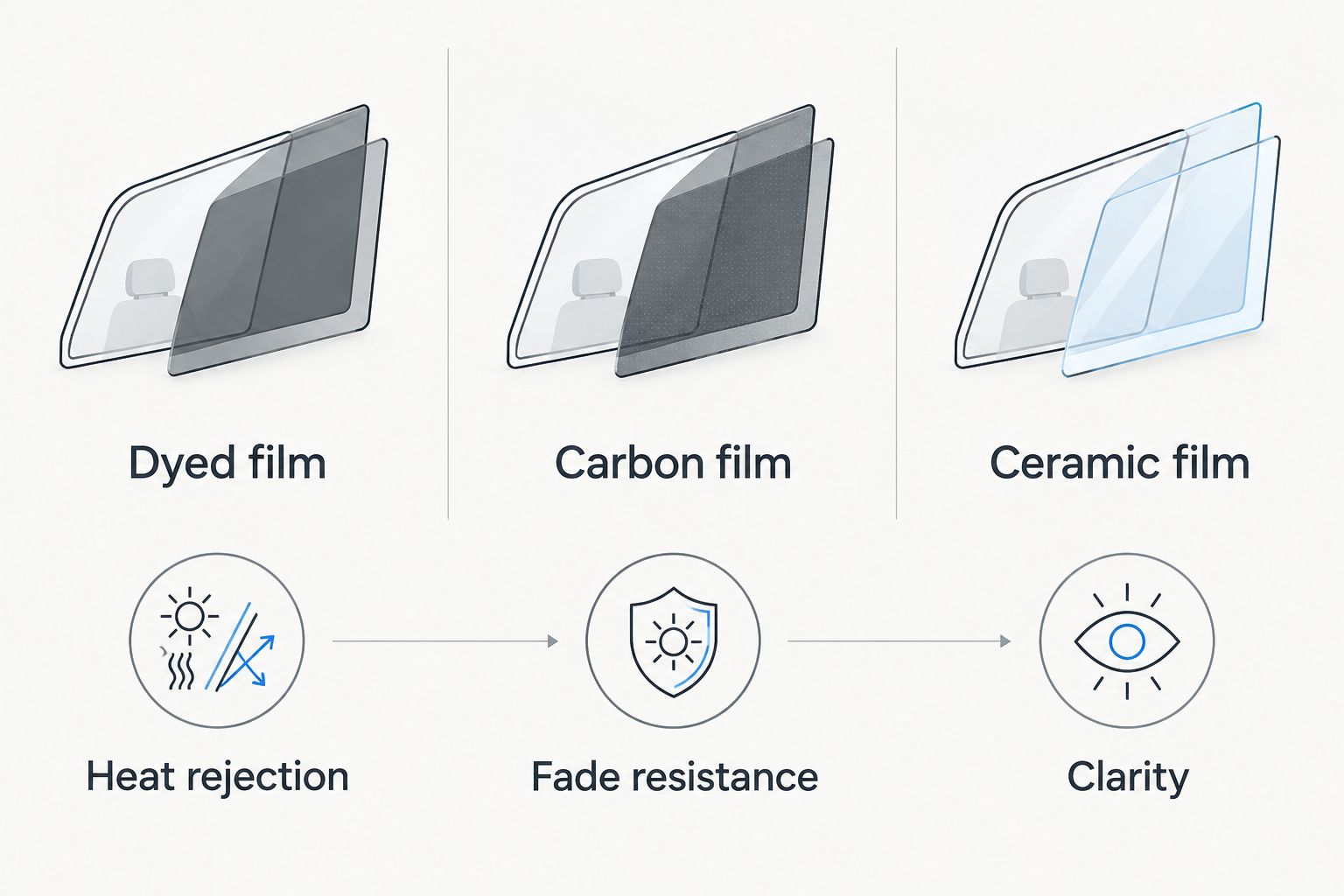
At a glance
| Brand | Best for | Standout feature | Key limitation |
|---|---|---|---|
| 3M Color Stable | Daily drivers | Long-term color stability, no purple fade | Heat rejection trails ceramic-only films |
| XPEL Prime XR Plus | Luxury/performance vehicles | Ceramic nano-technology, high clarity | Premium film means a longer install for multi-panel glass |
| SunTek CXP | Budget-conscious drivers | Carbon construction, no metal to interfere with signal | Heat rejection is good, not class-leading |
| LLumar CTX | RV and aircraft glass | Consistent performance across large flat panels | Overkill for a small daily-driver budget |
| Ceramic Pro Kavaca | Hot-climate heat rejection | Very high infrared blocking | Priced for buyers who prioritize heat over budget |
1. 3M Color Stable: best window tint brand for daily drivers
3M Color Stable uses a dye layer engineered to resist the fading and color shift that plagues cheaper films after a few North Carolina summers. It's the film most installers reach for when a customer wants something that still looks black in 2030, not purple.
3M Color Stable pros:
- Resists fading and bubbling over years of UV exposure
- Wide range of shades that stay within NC's 35% VLT rule
- Established track record on daily-driver glass
3M Color Stable cons:
- Heat rejection is solid but not the strongest on this list
- Not the first choice for owners chasing maximum interior cooling
Best for: daily drivers who want a film that looks the same in five years as it did on install day. Verdict: Buy.
2. XPEL Prime XR Plus: best window tint brand for luxury and performance vehicles
XPEL Prime XR Plus uses ceramic nano-particle technology instead of dye or metal, which means higher infrared rejection without darkening the cabin more than legally allowed. Owners of performance and luxury vehicles tend to gravitate here because the film keeps factory glass clarity while cutting cabin heat.
XPEL Prime XR Plus pros:
- Ceramic construction blocks more heat than dyed film at the same VLT
- No metal content, so no signal interference for GPS or toll tags
- High optical clarity, which matters on vehicles with advanced driver-assist cameras
XPEL Prime XR Plus cons:
- Multi-panel installs (curved rear glass, panoramic roofs) take longer to fit right
- Not the budget pick if cost is the deciding factor
Best for: luxury and performance vehicle owners who want heat rejection without sacrificing clarity. Verdict: Buy.
3. SunTek CXP: best budget window tint brand
SunTek CXP is a carbon film, which sits between dyed and ceramic in both cost and performance. It won't fade to purple, won't interfere with electronics, and gives a matte, non-metallic finish that reads as premium even on a tighter budget.
SunTek CXP pros:
- Carbon construction resists fading better than basic dyed film
- No metal layer, so it plays well with modern vehicle electronics
- A practical entry point for drivers new to tinting their vehicle
SunTek CXP cons:
- Heat rejection numbers trail true ceramic films
- Fewer premium shade options than the higher-tier brands
Best for: drivers who want a dependable film without stretching for ceramic pricing. Verdict: Buy.
4. LLumar CTX: best window tint brand for RV and aviation glass
LLumar CTX is built for consistency across large, flat glass panels, which is exactly what RV windshields, side windows, and small aircraft canopies demand. Where a passenger car has a handful of curved panels, an RV or plane has broad, flat expanses that show any inconsistency in film application immediately.
LLumar CTX pros:
- Performs evenly across large flat surfaces
- Solid UV blocking to protect RV interiors and aircraft avionics from sun damage
- Handles the scale of RV and aviation glass without visible seams
LLumar CTX cons:
- More film than a typical daily-driver sedan needs
- Not the natural pick if your only vehicle is a compact car
Best for: RV owners and private aircraft owners with large glass areas to protect. Verdict: Buy.
5. Ceramic Pro Kavaca: best window tint brand for maximum heat rejection
Ceramic Pro Kavaca leans hardest into infrared blocking of anything on this list, which matters most to owners parking outdoors through a full Carolina summer. It's a specialist's pick: if cabin temperature is your top complaint, this is the film built to solve it.
Ceramic Pro Kavaca pros:
- Strong infrared heat rejection, even at legal VLT levels
- Ceramic base means no signal interference
- Holds clarity well over time
Ceramic Pro Kavaca cons:
- Priced at the top of the category
- More film than most owners need if heat isn't the primary concern
Best for: owners in hot-climate parking situations who prioritize cabin cooling above all else. Verdict: Buy if heat is your main complaint, Hold if budget is tighter.
How we ranked these window tint brands
Each brand was measured against the six criteria above: heat rejection, color stability, UV protection, signal compatibility, optical clarity, and how well it fits inside North Carolina's 35% VLT rule. No brand failed compliance, since installers won't apply film that breaks state law, so the differences that matter come down to film construction and how each one behaves under Carolina sun over years, not days.
Which window tint brand should you choose?
If you're still deciding, 3M Color Stable is the safe default for a daily driver in 2026 — it resists fade, stays legal, and holds up. Step up to XPEL Prime XR Plus if you drive a performance or luxury vehicle and want the clearest, coolest cabin available. Go SunTek CXP if budget is the deciding factor and you still want a film that won't discolor.
For RVs and aircraft, LLumar CTX handles the scale. For anyone whose only complaint is heat, Ceramic Pro Kavaca solves that specific problem better than anything else on this list.
Book mobile window tint today
Royal Touch comes to you across North Carolina, Virginia, and South Carolina.
FAQ
What's the best window tint brand for North Carolina in 2026?
3M Color Stable is the strongest all-around choice for daily drivers because it resists fading and stays within NC's 35% VLT limit. Luxury and performance owners often prefer XPEL Prime XR Plus for its higher heat rejection and clarity.
Is ceramic window tint better than carbon tint?
Ceramic film generally blocks more infrared heat than carbon film at the same visible light transmission. Carbon film like SunTek CXP still resists fading and costs less, making it a reasonable middle ground.
How dark can window tint legally be in North Carolina?
North Carolina requires front and back side windows to allow at least 35% visible light transmission. The windshield can only carry a nonreflective tint strip on the top 5 inches.
Does window tint block UV rays?
Quality window film typically blocks up to 99% of UV rays, which protects skin, upholstery, and dashboard materials from sun damage. This holds true across dyed, carbon, and ceramic film categories.
Can window tint interfere with GPS or cell signal?
Films with metal content can interfere with GPS, toll transponders, and cell signal in some vehicles. Carbon and ceramic films like SunTek CXP and XPEL Prime XR Plus avoid this because they contain no metal layer.
What window tint brand works best for RVs and aircraft?
LLumar CTX is built for large, flat glass panels, which makes it a strong fit for RV windows and small aircraft canopies. Consistency across a big panel matters more there than it does on a sedan's side window.
How long does window tint last?
Higher-quality ceramic and carbon films resist fading far longer than basic dyed film, though exact lifespan depends on climate exposure and installation quality. A film that holds its color and heat rejection over years is worth the difference in construction quality.
One last thing
Window tint and ceramic coating solve different problems, but owners who invest in one tend to invest in the other. If you're already planning tint for 2026, it's worth checking what ceramic coating costs before you book, since pairing both services in one mobile visit protects your interior and exterior at the same time. Royal Touch treats every vehicle, RV, and aircraft with the same standard: done right the first time, no shortcuts on prep or application.